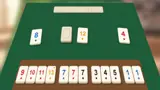
Okey
Build runs and sets on your rack, the okey fills any gap
How to play
Okey on Matsuri is free online Okey, the Turkish tile rummy, for four players with the computer in any empty seat: build runs and sets on your rack, use the wild okey tile well, and be the first to lay your rack down. Play three computers, send friends an invite link to play in Telegram or any browser, or pass one phone round the table. It runs on phone or desktop and inside Telegram via @MatsuriGamesBot, with no download or sign-up.
Okey is the tile game played in every Turkish tea house: 106 tiles numbered 1 to 13 in four colours, two of each, and two false jokers. One tile is turned up as the indicator, and the tile of its colour one number higher is the okey, a wild tile that stands for anything. Everyone holds 14 tiles on a rack, the starter 15. On your turn take the tile the player on your left threw, or the top of the pile, then throw one to your right. Finish by throwing your fifteenth tile with the other fourteen all in runs (three or more of one colour in a row) and sets (three or four of one number in different colours), or in seven pairs. Play the computer, invite friends by link, or pass one phone round.
- Everyone gets 14 tiles, the starter 15. The tile turned up in the middle is the indicator: the tile of its colour one number higher is the okey, a wild tile that stands for anything (it wears a little star on your rack). The clover tile is a false joker: it simply plays as the okey's own tile.
- On your turn, take the tile on your left or one from the pile, then throw a tile onto your right. Drag tiles to arrange your rack as you like, or tap Sort: runs or Sort: sets.
- Finish by dragging your 15th tile to the middle while the other 14 are all in runs (three or more of one colour in a row; 12-13-1 counts) and sets (three or four of one number, every colour different), or in seven pairs. That's 2 points, 4 for seven pairs, and double when the tile you finish on is the okey. If the pile runs out, nobody wins.
How to play Okey (classic rules)
The game uses 106 tiles: the numbers 1 to 13 in four colours (red, yellow, blue and black), two of each, and two false jokers. One tile is turned face up at the start; this is the indicator. The tile of the same colour one number higher is the okey, and both copies of it are wild: each can stand for any tile. If the indicator is a 13, the 1s of its colour are the okey. A false joker is not wild. It carries a clover instead of a number and plays only as the okey's own tile, so with a yellow 6 as the indicator a false joker is a yellow 7.
Everyone gets 14 tiles and the player who starts gets 15. The starter begins by throwing one tile. After that, each turn has two parts: first take a tile, either the one the player on your left has just thrown or the top tile of the face-down pile, then throw one tile onto your right, where the next player may take it. Only the top tile of each discard pile can be taken.
You win the hand by throwing your fifteenth tile while the other fourteen are all in groups. A run is three or more tiles of one colour in a row; the 1 may follow the 13 (12-13-1), but a run cannot go on through it (13-1-2 is not allowed). A set is three or four tiles of one number, every one a different colour. Instead of groups you may also finish with seven pairs of identical tiles. Here a finish is worth 2 points, seven pairs 4, and either one doubles when the tile you finish on is an okey. If the pile runs out and the next player does not want the tile on their left, the hand ends with no winner.
Okey strategy and tips
- Keep the tiles that can be completed in more than one way. A 5 and 6 of one colour can become a run with a 4 or a 7, while a 5 and 7 need exactly a 6.
- Hold on to your okey tiles. They fill any gap, and finishing by throwing one is worth double.
- Read the discards. Count the copies of the tiles you are waiting for that have already been thrown, and change plans when there are none left.
- Throw safely. Avoid giving the player on your right a tile that obviously fits what they have been picking up, and prefer tiles that player has thrown before.
- Think about seven pairs early. With four or five pairs in your first rack, collecting pairs can be quicker than building runs and sets, and it scores more.
Modes and difficulty
Play the computer: three computers take the other seats. They keep the tiles that make groups, take a discard only when it really helps, and finish as soon as they can, and a newcomer's first two tables are a little gentler. Play friends: open a table and send the invite link for up to four people; the host can start early and fill empty seats with computers. Two to four on one phone: pass the phone, and a cover screen between turns hides each rack. No account needed.
Playing Okey on Matsuri
The server deals the tiles and keeps every rack; each player's page receives only their own tiles, and the server checks every move and every finish, so nobody can peek or cheat. Your rack has two rows: drag tiles where you like, or sort it in one tap by runs or by sets. The okey on your rack wears a small star, and the indicator and the okey it makes are shown in the middle. Where people search for plain Okey, the table opens as a classic green felt table; in other languages it is a candy table with Mocha, the hall's host, and either look can be picked. A game pays a little candy once at least 24 moves have been played: against friends 15 for a win, 8 for a draw and 5 for a loss, against the computer 6 for a win, within the day's candy budget.
A little history
Okey belongs to the rummy family, played with tiles instead of cards, close to Rummikub (created in the 1930s) and, further back, to Chinese tile games. In Turkey it became the favourite table game of the second half of the 20th century: it is played in tea houses and coffee houses in every town, at home with family, and on phones by millions, alongside its popular cousin 101 Okey, which adds an opening score and laying groups on the table.
Questions
- How do you play Okey?
- Okey uses 106 tiles: 1 to 13 in four colours, two of each, and two false jokers. Everyone holds 14 tiles on a rack and the starter 15. On your turn you take the tile the player on your left just threw, or the top tile of the pile, and then throw one tile to your right. You win by throwing your fifteenth tile while the other fourteen are all in runs (three or more of one colour in a row) and sets (three or four of one number in different colours), or in seven pairs.
- What is the okey tile, and what is the false joker?
- A tile is turned face up at the start: the indicator. The tile of the same colour one number higher is the okey, and both copies of it are wild: each can stand for any tile you need. A 13 as the indicator makes the 1s okey. The two false jokers, with a clover on them, are not wild: each one simply plays as the okey's own tile.
- Can I win with seven pairs?
- Yes. Seven pairs of identical tiles, the same number in the same colour, finish the hand too, and they are worth twice an ordinary finish. An okey can pair with any tile.
- What happens when the pile runs out?
- The next player may still take the tile on their left. If they don't want it, the hand ends with no winner and counts as a draw.
- Is this classic Okey or 101 Okey?
- This is classic Okey: the first player to finish their rack wins the hand. There is no 101-point opening and no laying groups on the table during play; 101 Okey is a different game with its own scoring.
- Can I play Okey with friends or against the computer?
- Yes, for free. Play three computers, send friends an invite link for a table of up to four (the host can fill empty seats with computers), or pass one phone round between two to four people. No download or sign-up.