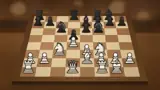
Chess
Corner the other king: checkmate wins
How to play
Chess on Matsuri lets you play chess online against the computer or a friend, on the standard 8 by 8 board with the full rules: castling, en passant, promotion, check and checkmate. Send a friend an invite link to play in Telegram or any browser, pass one phone between two people, or take on the computer. It runs on phone or desktop and inside Telegram via @MatsuriGamesBot, with no download or sign-up.
Chess for two on the standard 8 by 8 board with the full rules. White moves first; tap a piece and its legal squares light up, then tap one to move. Castling, en passant and promotion (you pick queen, rook, bishop or knight) all work as in any tournament. Checkmate wins; stalemate, threefold repetition, the fifty-move rule and positions where nobody can mate are drawn automatically, and either player may resign. Send a friend the invite link to play in Telegram or any browser, pass one phone between two players, or play the computer, which looks a few moves ahead and counts every capture through.
- Tap one of your pieces: the squares it may go to light up (a ring means a capture). Tap one, or drag the piece there.
- Castle by moving the king two squares toward a rook. A pawn that reaches the far end becomes the piece you pick; en passant works too.
- Checkmate wins. Stalemate, threefold repetition, the fifty-move rule and too little material are draws, called automatically.
How to play chess (rules)
Each side starts with sixteen pieces in the standard position, and White moves first. Whoever opens the table plays White in the first game, and in a rematch the colours swap. Pawns step forward and capture diagonally, knights jump in an L, bishops slide diagonally, rooks slide along ranks and files, the queen does both, and the king steps one square. To move, tap or click a piece: the squares it can legally go to are marked with dots, and captures with a ring. Tap one to move, or drag the piece there.
Three special moves work as in any tournament game. Castling moves the king two squares towards a rook and the rook jumps over it: tap the king, then its castling square, on either side if the squares between are empty and neither piece has moved. En passant lets a pawn capture an enemy pawn that has just stepped two squares past it. A pawn that reaches the far rank is promoted, and a picker offers a queen, rook, bishop or knight. A king in check is highlighted red, the last move is highlighted, and captured pieces are shown beside the board.
Checkmate, a king in check with no way out, wins the game. Draws are declared automatically: stalemate, threefold repetition (the same position with the same player to move three times), the fifty-move rule (fifty moves by each side with no capture and no pawn move) and insufficient material, such as king against king, king and a single bishop or knight against king, or kings with bishops on the same colour. There is no draw button and no chess clock, and either player may resign at any time.
Chess strategy and tips
- Fight for the centre. Pawns on e4 and d4, or e5 and d5, give your pieces room and take squares away from your opponent.
- Develop knights and bishops before moving the queen out. A queen that comes out early is easy to chase, and every tempo spent chasing it is a tempo your opponent gains.
- Castle early. It tucks the king behind a wall of pawns and brings a rook towards the centre. Do not move the pawns in front of your castled king without a reason.
- Before every move, ask what the last move threatens. Check that none of your pieces is left undefended, and look for forks, pins and pieces your opponent has left hanging.
- Put rooks on open files, and keep your pieces working together. In the endgame the king becomes a fighting piece, so bring it towards the centre and push passed pawns.
Modes and difficulty
Play the computer: it searches a few moves ahead, then follows every capture to the end, judging material and where the pieces stand. It thinks for about a quarter of a second a move and never leaves a piece hanging, so it beats most casual players, but someone who plans and knows basic tactics can beat it. Play a friend: open a table and send the invite link; anyone else who opens it can watch. 2 players, 1 phone: two people share one device, passing it back and forth, and nothing is recorded or paid there. There are no levels or rankings. A table with a friend has no clock, but a turn left for a whole day loses the game; a game against the computer that nobody touches for an hour is closed.
Playing Chess on Matsuri
The server keeps the board and checks every move, so only legal moves can be played, and it decides checkmate and every kind of draw. A game pays a little candy once at least 20 moves have been played: against a friend 15 for a win, 8 for a draw and 5 for a loss, against the computer 6 for a win, within the day's candy budget. The board comes in a classic look, with a wooden board and standard pieces, and a candy look where Mocha, who runs the hall, is the opponent and cheers you on.
A little history
Chess grew out of chaturanga, a game played in India around the 6th century, and travelled to Persia, where it was called shatranj, and on to the Arab world and Europe. The modern queen and bishop, which made the game much faster, took shape in Spain and the rest of Europe in the late 15th century. Wilhelm Steinitz is counted as the first official world champion, in 1886. In 1997 the computer Deep Blue beat the reigning champion Garry Kasparov in a match, a landmark for chess and for computers.
Questions
- Can I play chess online with a friend?
- Yes. Open a table, send the invite link, and your friend plays in Telegram or any browser. Anyone else who opens the link can watch. There is no download or sign-up.
- Does it use the full rules of chess?
- Yes: castling on both sides, en passant and promotion to a queen, rook, bishop or knight, with every move checked by the server. Only legal moves can be played.
- How do draws work?
- They are declared automatically: stalemate, threefold repetition, the fifty-move rule and positions where neither side can mate. There is no draw offer button, and either player can resign at any time.
- How strong is the computer?
- It searches a few moves ahead and follows every capture to the end, so it never leaves a piece hanging and beats most casual players. A player who plans ahead and knows basic tactics can beat it.