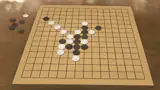
Gomoku
Take turns placing stones, first five in a row wins
How to play
Gomoku on Matsuri is free online five in a row for two players: take turns putting black and white stones on a 15 by 15 board, and the first to make an unbroken line of five wins. Play the computer, send a friend an invite link, or pass one phone between two people sitting together. It runs on phone or desktop and inside Telegram via @MatsuriGamesBot, with no download or sign-up.
Gomoku, also called five in a row, is a two-player game on a 15 by 15 board. Black moves first, then you take turns putting one stone on any empty point where the lines cross. Five or more of your stones in an unbroken line, across, down or diagonally, wins at once; these are the free-style rules, with no renju limits on black. A full board with no five is a draw. On a phone, the first tap shows where your stone will go and a second tap puts it down. Send a friend the invite link, pass one phone between two players, or play Mocha, who blocks every four and open three and looks four moves ahead.
- Take turns putting a stone on any empty point where the lines cross. Black, the first player, goes first.
- Five or more of yours in an unbroken line wins: across, up and down, or diagonal.
- Watch for an open three (three in a row with both ends free) and block one end, or it becomes a four that can't be stopped. A full board is a draw.
How to play gomoku (five in a row)
The board has 15 lines each way, and stones go on the points where the lines cross, not inside the squares. Black moves first, then the players take turns putting one stone on any empty point; stones never move and are never taken. Five or more of your stones in an unbroken straight line, across, down or diagonally, win at once, and the winning line is struck through. These are the free-style rules: a line of six or more also wins, and black has none of the renju limits on double threes or double fours. If all 225 points fill with no five, the game is a draw. In a rematch the seats turn, so the other player gets black.
On a phone the points are close together, so a stone goes down in two taps: the first tap shows a see-through stone on the nearest point, with its row and column lit so you can see it past your finger, and a second tap on it puts it down. Tap somewhere else, or drag, to move it first. With a mouse, the point under the pointer shows your stone and a click puts it down; on a keyboard, the arrow keys move the stone and Enter or Space puts it down. The last stone played carries a small mark, so you always see the other player's move.
Gomoku strategy and tips
- Start near the middle. A stone in the centre is part of many more possible lines of five than one near the edge, which is why black opens there.
- Block open threes. Three in a row with both ends empty becomes an open four on the next move, and an open four cannot be stopped, because it has two ways to make five. Close one end of an open three as soon as you see it.
- Always answer a four. A four with one gap left wins on the next move unless you fill that gap, so look for fours first, every turn, before your own plans.
- Build two threats with one stone. A stone that makes a four and an open three at once, or two open threes, leaves the other player able to block only one of them. This fork is how most games of gomoku are won.
- Attack with fours. Each four forces a reply in one exact place, so a chain of fours lets you place stones while the other player can only block; if the chain ends in a double threat, the win is yours.
- Keep your stones connected. Stones a step or two apart on the same lines support each other, while scattered stones give the other player time to build.
Modes and difficulty
Play the computer: it blocks every four and every open three, finds a win by a chain of fours when one is there, and looks four moves ahead, so a careless move is punished, but a well planned double threat beats it. Play a friend: open a table and send the invite link; the game starts when they sit down. Two players, one phone: both play on this device, taking turns, with nothing to sign in to. After a game, ask for a rematch with the colours swapped. There are no levels or rankings.
Playing Gomoku on Matsuri
The server keeps the board and checks every stone, so a game in a Telegram group chat or a browser tab is the same game for both players, and a game against a friend can go at its own pace: each turn may take up to a day. A game pays a little candy once at least nine stones are on the board, the quickest possible win, so a resign at once pays nothing: against a friend 15 for a win, 8 for a draw and 5 for a loss, against the computer 6 for a win, within the day's candy budget. A game on one phone pays nothing and is not recorded. The board comes in a candy look with chocolate and strawberry sweets, or a classic look with a wooden board and black and white stones.
A little history
Five in a row is played with go stones on a go board, and its Japanese name, gomoku narabe, simply means five stones in a row. It was already popular in Japan in the nineteenth century; in 1899 the journalist Kuroiwa Ruikō gave the competitive form the name renju, and over the following decades renju added limits on black, because the player who moves first has a strong advantage. In 1994 Victor Allis showed by computer that in free-style gomoku on a 15 by 15 board, black can always force a win with perfect play. The game travelled widely under other names: Koreans play it as omok, and in Vietnam it is co caro, drawn with X and O on squared paper in school notebooks, as players in Russia and Ukraine draw five-in-a-row noughts and crosses.
Questions
- What are the rules of gomoku here?
- Free-style gomoku on a 15 by 15 board: black moves first, players take turns putting one stone on any empty point, and five or more in an unbroken line across, down or diagonally wins. There are no renju limits on black, and a full board with no five is a draw.
- Is gomoku the same as five in a row?
- Yes. Gomoku is the Japanese name of five in a row, also called gobang, omok in Korea and co caro in Vietnam. The game is the same: the first to line up five stones wins.
- Can I play gomoku online with a friend for free?
- Yes. Open a table and send the invite link, and your friend plays in Telegram or any browser, free with no download or sign-up. Sitting together, you can also both play on one phone.
- How strong is the computer at gomoku?
- It blocks every four and open three, finds a win by a chain of fours, and looks four moves ahead, so it beats most casual players. A well planned double threat still gets past it.