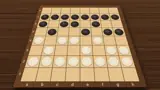
Turkish Draughts
Jump straight ahead, take the most, crown a dama
How to play
Dama on Matsuri is free online Turkish draughts for two players: sixteen men each on an 8 by 8 board where every square is used, straight and sideways moves, the longest capture as a must, and flying kings. Play the computer, send a friend an invite link to play in Telegram or any browser, or pass one phone between two people. It runs on phone or desktop and inside Telegram via @MatsuriGamesBot, with no download or sign-up.
Turkish draughts, called Dama in Turkey, for two on an 8 by 8 board where every square is used. Each side starts with sixteen men on its second and third rows. Men step one square straight forward or sideways, never backward or diagonally, and capture the same ways by jumping an enemy piece next to them onto the empty square beyond. Capturing is compulsory and you must take the sequence that captures the most pieces; pieces leave the board as they are jumped, and a capturing piece may not turn straight back. A man that ends its move on the far row becomes a king (dama), which moves like a rook and captures from a distance. You win by taking every piece or leaving the other side no move; one king against one king is a draw. Play the computer, send a friend a link, or play two on one phone.
- Tap one of your pieces, then a dotted square. Men step one square forward or sideways, never back; a king (dama) glides any distance along a row or a column.
- Capturing is a must: jump the piece right in front of you or beside you to the empty square beyond, and keep jumping while you can. When there is a choice, take the way that captures the most.
- End a move on the far row to crown a dama. Take every piece, or leave the other side no move, to win; one dama against one dama is a draw.
How to play Turkish draughts (Dama rules)
Each side starts with sixteen men on its second and third rows; the back rows start empty, and White, at the bottom, moves first. A man steps one square straight forward or one square sideways onto an empty square. It never moves backward and never diagonally. A man that ends its move on the far row becomes a king, called a dama, which moves any number of empty squares along a row or a column, like a rook in chess.
Captures are compulsory. A man captures by jumping an enemy piece right in front of it or right beside it onto the empty square just beyond; a dama captures from a distance, jumping a single piece anywhere along its row or column, with only empty squares between, and landing on any empty square past it. After a jump the same piece keeps jumping while there is more to take, and may turn at right angles but never straight back the way it came. Among all the captures on the board you must play one that takes the most pieces, a dama counting as one; between equal ones you choose. Each piece leaves the board the moment it is jumped, so its square is free for the rest of the move. A man that reaches the far row in the middle of a capture goes on as a man and is crowned only if the move ends there.
You win when the other side has no move left, because all its pieces are taken or all of them are blocked. One dama against one dama is a draw, unless the side to move can take the other at once. The game is also drawn when the same position comes up for the third time with the same player to move, or after 25 moves each with nothing taken and no man stepping forward. To move, tap one of your pieces and then a dotted square; the pieces that must capture wear a ring, and in a capture with several jumps the board stops on each landing so you can choose the next one.
Dama strategy and tips
- Move in blocks. Two men side by side, or one right behind another, protect each other, because a jump needs an empty square beyond the piece; a lone man pushed ahead is the easiest target on the board.
- Use the longest-capture rule. Since the other side must take the most it can, offering one man can drag its piece onto a square from which you take two or three back.
- Every step forward is for good. Men can't come back, so don't leave holes behind your front line: a gap lets an enemy man slip through to your back row and crown.
- A dama is worth about three men and controls whole rows and columns. Keep files toward your far row closed, and when you get the first dama, use it to pick off loose men from a distance.
- Count before every exchange. When you are ahead, trade pieces so your lead counts; when you are behind, avoid trades and keep your men packed together.
Modes and difficulty
Play the computer: it looks three moves ahead for each side and always plays out the captures at the end of what it sees, so it rarely leaves a piece hanging; a casual player usually loses to it, but a careful one can win, and it goes easier on your very first games. Play a friend: open a table and send the invite link, and the game starts when they sit down. Two players, one phone: both sit at the same screen and take turns, the board seen from White's side, with no account needed. After a game, ask for a rematch and the other side starts.
Playing Turkish Draughts on Matsuri
The server keeps the board and checks every move by the rules, the longest-capture rule and multi-jumps included, so nobody can play a move the rules do not allow, and the pieces that must capture are ringed for you. In languages where people play plain dama, the table opens on a classic lined wooden board with ivory and black pieces; elsewhere it opens with candy pieces on a pistachio board, and either look can be picked under the board. A game pays a little candy once at least 16 moves have been played: against a friend 15 for a win, 8 for a draw and 5 for a loss, against the computer 6 for a win, within the day's candy budget.
A little history
Dama has been played across Turkey and the eastern Mediterranean for centuries, on boards scratched into stone benches as well as on wooden ones in coffee houses, and closely related games are played in Greece, Armenia (tama), Lebanon, Kuwait and Egypt. Unlike the diagonal draughts of Europe, its pieces move along rows and columns and use every square. In Turkey it sits beside tavla as the everyday board game, with its own federation and championships, and to most Turks the word dama simply means this game, while the diagonal one is known as Russian or international draughts.
Questions
- What are the rules of Turkish draughts (Dama)?
- Every square of an 8 by 8 board is used and each side has sixteen men on its second and third rows. Men step one square forward or sideways, never backward or diagonally, and capture the same ways by jumping. Capturing is compulsory and the sequence that takes the most pieces must be played. A man that ends its move on the far row becomes a king (dama), which moves and captures any distance along rows and columns.
- Must I take the most pieces in Dama?
- Yes. If any capture is possible you must capture, and among all the captures you must play one that takes the most pieces; a king counts as one piece. When two ways take the same number, you choose. The pieces that can make such a capture wear a ring.
- What happens when a man reaches the last row in the middle of a capture?
- It carries on capturing as a man, along the last row if it can, and is crowned only if its move ends there. Pieces are removed as they are jumped, and a capturing piece may not turn straight back the way it came.
- How does a game of Dama end in a draw?
- One king against one king is a draw. So is the same position coming up a third time with the same player to move, or 25 moves each with nothing taken and no man stepping forward. Otherwise the player who loses every piece, or has no move left, loses.
- Is this the same as checkers?
- No. Checkers (Russian or English draughts) is played on the dark squares only, with diagonal moves. Dama uses every square, moves straight and sideways, and makes the longest capture compulsory. Both are in the hall: look for Checkers too.